Methods Overview
PsycheBench Labs investigates patterns in AI-generated language using structured, qualitative research methods inspired by psychology, ethics, and narrative analysis.
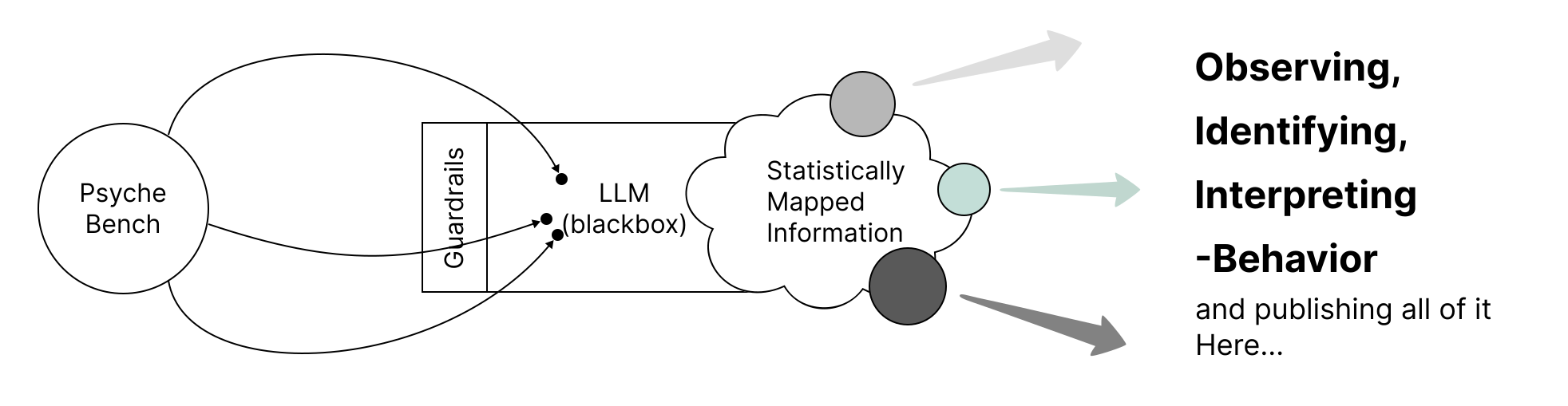
Our approach does not assume that AI systems possess inner experiences, intentions, or emotions. Instead, we examine how language models behave under specific conversational and contextual conditions, particularly when responding to open-ended, ambiguous, or emotionally charged material.
The methods below represent broad categories of inquiry. Detailed protocols, datasets, and interpretive frameworks are available to registered researchers.
Scenario-Based Probing
We use carefully designed, open-ended scenarios that have no correct answers. These scenarios are intended to surface how models:
- Frame moral or social dilemmas
- Allocate responsibility
- Balance competing constraints
- Resolve ambiguity
Rather than measuring correctness, we examine patterns of response structure and narrative positioning.
Multi-Turn Interaction Analysis
Certain studies involve extended, multi-turn conversations. These allow us to observe how AI responses evolve when:
- Emotional tone shifts
- The interaction introduces validation, challenge, or tension
- Motivation for ambiguity is standardized in the setting
This helps identify consistency, adaptability, and boundary-maintenance patterns over time.
Reflective & Interpretive Prompts
Some methods introduce metaphorical or theory-driven reflections drawn from psychology, philosophy, and related disciplines. These prompts are designed to observe how models:
- Engage with abstract human concepts
- Translate metaphor into explanation
- Position themselves relative to relational or social frameworks
This helps identify consistency, adaptability, and boundary-maintenance patterns over time.
Side-by-Side Slightly Varying Prompt Comparison
We present pairs (or small sets) of prompts with only minor wording differences, submitted separately to the same model. This allows us to observe how small changes affect:
- Framing of responses
- Emphasis on particular concepts or constraints
- Consistency of reasoning
- Sensitivity to linguistic nuance
Rather than evaluating correctness, we examine how stable or variable responses remain under minimal prompt changes.
Why This Matters
As AI systems increasingly participate in sensitive domains like: education, mental health, governance, and social mediation - understanding their behavioral tendencies in language becomes essential.
PsycheBench Labs aims to provide a transparent, methodologically cautious foundation for such understanding.
Registered collaborators gain access to full protocols, annotations, and ongoing methodological discussions.
Interpretation and Limitations
All findings produced by PsycheBench Labs are provisional, context-dependent, and interpretive. We do not claim to reveal underlying mechanisms, ground truth, or stable properties of models. Our observations describe behavior in specific contexts; they do not generalize automatically to other settings.
Language behavior is not equivalent to cognition, intention, or subjective experience. We use psychological frameworks as interpretive tools, not as evidence of psychological reality in AI systems.
Multiple interpretations of the same behavior may be valid. We document patterns; we do not adjudicate their ultimate meaning. Researchers are encouraged to approach findings as openings for inquiry rather than settled conclusions.
Access to Full Methods
Registered researchers gain access to detailed method specifications, annotated examples, scoring rubrics, and ongoing methodological discussions. This includes specific prompts, interaction protocols, and interpretive frameworks used in active research.
If you are conducting research in AI safety, behavioral analysis, or adjacent fields and would like access, please reach out through the Join Form.